Why Legacy CPQ No Longer Fits Modern Revenue
Traditional CPQ was designed for simple, one-time deals. Modern revenue models now rely on subscriptions, usage-based pricing, and bundled offerings.
Legacy systems lack the AI, automation, and end-to-end quote-to-revenue capabilities of current platforms, and no longer align with today’s revenue generation.
This misalignment creates manual bottlenecks and data silos that prevent businesses from scaling dynamic pricing or managing complex contract lifecycles effectively.
Choosing the Right CPQ Alternative
Among the leading CPQ alternatives (Conga, Zuora CPQ, Agentforce Revenue Management, or NetSuite) the key challenge is alignment, not
availability. We partner across all four with zero vendor bias and recommend solely based on your revenue model and growth stage.
Why Choose It
This next-generation successor to legacy Salesforce CPQ is designed for complete revenue operations, covering everything from quoting and subscriptions to billing, order management, and revenue recognition.
-
Pros
- Best for Salesforce-centric organizations needing native CPQ, billing, subscriptions, revenue recognition, and Flow approvals
- Unified end-to-end quote-to-revenue platform with integrated analytics
- Unified data model linking sales and finance
-
Cons
- More complex to implement compared to basic CPQ
- Higher total cost, including platform, billing, and adoption efforts
- Steeper learning curve for administrators

Cost Implications
While initial implementation requires a higher upfront investment, the platform delivers a strong long-term ROI by significantly reducing integration expenses for organizations with complex revenue processes.
Best suited for usage-based businesses that need native billing, complete revenue visibility, and unified end-to-end revenue operations.
Get StartedWhy Choose It
Robust Quote-to-Contract-to-CLM workflow fully integrates legal processes, approvals, and document automation into a single, seamless operation.
-
Pros
- Best for organizations managing complex configurations across products, regions, and compliance needs
- Strong Conga CLM integration with flexible pricing logic
- Salesforce-native, built for flexibility beyond CPQ/RCA roadmap
-
Cons
- Weaker subscription and billing capabilities
- Less intuitive for sales reps compared to Salesforce CPQ
- Smaller overall ecosystem
Cost Implications
While this solution is cost-effective when contract management is the primary challenge, implementation complexity tends to grow as additional modules are integrated.
Best suited for contract-heavy sales environments with legal-driven processes across services and products.
Get StartedWhy Choose It
Built specifically for subscription monetization, this platform supports recurring billing while effortlessly handling contract amendments, proration, and complex usage-based pricing.
-
Pros
- Advanced subscription lifecycle management for complex subscription models
- Strong capabilities in proration, renewals, and contract amendments
- Integrates with multiple CRM platforms
-
Cons
- Limited capabilities for complex physical product configuration
- Lacks a native sales user experience; requires CRM integration
- Often depends on Salesforce CPQ or a custom UI to support sales workflows
Cost Implications
This platform typically requires additional costs for CRM integration and involves a longer implementation cycle.
Best suited for subscription and usage-based pricing models with high-volume renewals and complex billing requirements.
Get StartedWhy Choose It
By embedding CPQ directly within the ERP system, businesses can unify inventory, finance, and revenue data to drive significant operational efficiency.
-
Pros
- Strong alignment with NetSuite’s ERP and eCommerce for seamless finance, inventory, and manufacturing data sync
- Robust 3D product visualization capabilities
- Auto-generates BOMs and work orders from sales configurations
-
Cons
- Sales user experience is less polished compared to Salesforce
- Discounting logic is less flexible
- ERP upgrade cycles can affect CPQ performance and stability
Cost Implications
The platform offers lower integration costs because the ERP is native, though ongoing administration costs remain tied to the broader ERP ecosystem.
Best suited for manufacturing-focused businesses seeking minimal integration overhead.
Get StartedCPQ Feature–Platform Comparison:
Core Strengths at a Glance
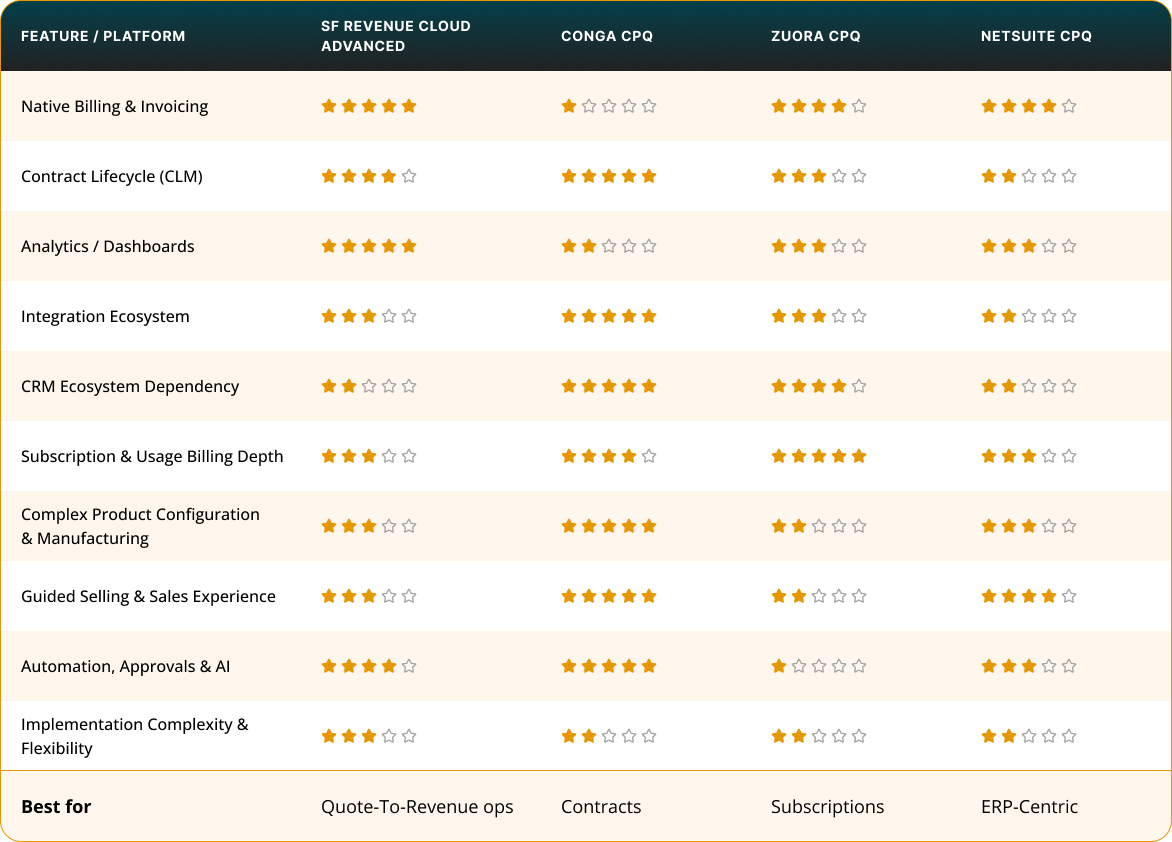
There’s no “best” platform. There’s only the one that fits your growth model.
Our Proven, Revenue-Safe Migration Approach
Switching CPQ systems isn’t a lift-and-shift. It’s a revenue architecture redesign.
Here’s how we approach it:

CPQ Assessment
We audit pricing logic, approval flows, catalog structure, integrations, and technical debt.

Pricing & Catalog Redesign
Simplify bundles. Rationalize SKUs. Eliminate unnecessary customizations. Build for scale.

Data & Integration Migration
Quotes, contracts, pricing rules, and historical records were migrated with precision. ERP, billing, and CRM integrations are rebuilt intentionally, not patched together.

Adoption & Change Enablement
We prioritize usability, enablement, and executive alignment from day one.
We don’t treat migration as IT execution. We treat it as revenue transformation. Get Started...
Plan Your CPQ Migration With
Confidence
With 18+ years of deep expertise and 1200 experts, Grazitti Interactive has guided hundreds of enterprises through complex transformations, from legacy CPQ migrations to modern revenue platforms, seamless data transitions, and end-to-end quote-to-cash redesigns.
We deliver:
- Minimal downtime and zero revenue disruption
- Tailored strategies that simplify technical debt and scale with your business
- Proven results like faster quote cycles, improved billing accuracy, and higher adoption rates
Our client-first approach, backed by global delivery, industry recognition, and custom tools, ensures your migration isn't just a project, it's a revenue reset.